Savez za sport i rekreaciju FBIH
Ten Local Events, One Big Question: Can Sport Really Work for Everyone?
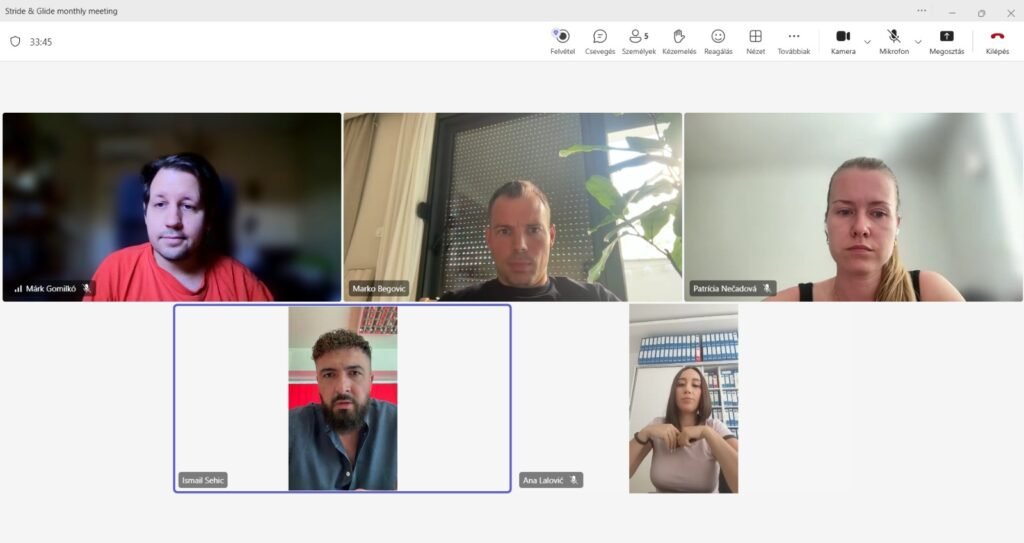
STRIDE & GLIDE partners met online on 10 August 2026 to check progress and map out the project’s busiest stretch yet.
Four organisations, one call. Representatives from Verlab Institute (Bosnia and Herzegovina), REGSPO (Montenegro), the Sports and Recreation Association of the Federation of Bosnia and Herzegovina (SZSR FBiH), and ACTIVE Austria logged on to go through five things: the second round of Training of Trainers, local events, sports equipment, the upcoming project conference, and how the project talks about itself online.
Why this project exists
STRIDE & GLIDE — full name “Empowering Journeys for All Abilities” — starts from a simple idea: running, swimming and hiking should be genuinely open to people with disabilities, not accessible in theory only. That means training the people who run the sessions, not just the people taking part.
The consortium spans four countries — Bosnia and Herzegovina, Montenegro, Austria and Portugal — and pulls together some very different kinds of expertise: sport, research, education, civil society. SZSR FBiH leads the coordination; alongside Verlab Institute and the University of Sarajevo’s Faculty of Sport and Physical Education, REGSPO, ACTIVE Austria and Portugal’s Sport Embassy round out the team.
The underlying pitch is that accessibility shouldn’t be bolted on as a side activity, it belongs in how sport gets planned from the start.
Training is already paying off
REGSPO came into the meeting with good news: its Training of Trainers activities are done, reaching roughly 150 participants.
One rule got reinforced for everyone else: training sessions and local events can happen on the same day if it makes sense logistically, but they can’t be blurred together. Each needs its own participant list and its own paperwork. Photos, video, records — partners were reminded to document everything properly.
Deadline for wrapping this stage up: 20 September 2026.
Equipment that actually gets used
This isn’t a project about talking through accessibility in a meeting room, partners want people to try it. Each organisation is buying at least one piece of equipment for its local activities, whether that’s for hiking, running or swimming, and it has to see real use at the local events. Options on the table include JOËLETTE and SOFAO gear, both built for outdoor and mobility-based activity.
ACTIVE Austria is coordinating the final calls on what gets bought before the local events roll out.
Ten events, real communities
The next stretch is about ten local events: the point where the project stops being a conversation between partner organisations and starts showing up in actual communities.
Partners have room to be flexible here: a STRIDE & GLIDE activity can be folded into a bigger local event, as long as it’s clearly visible and genuinely happening, not just a logo on a banner. Speaking of which — banners, photos, testimonials, all expected.
What these events are meant to do:
- bring inclusive running, hiking and swimming to local communities
- show adapted equipment and accessibility solutions in action
- get people with and without disabilities doing activities together
- build up trainers’ and organisations’ capacity to run inclusive sport
- gather real participant stories
- connect clubs, professionals, institutions and civil society groups
- push the message of equal participation and inclusion
- leave behind models partners can keep using after the project ends
Getting louder, not just staying active
Communication got its own conversation. Partners agreed dissemination needs to get more consistent as things ramp up — and were nudged to actually tag the project’s channels and each other so content travels further instead of sitting in one organisation’s feed.
It’s not just about the big milestones, either. Any talk, meeting or event connected to STRIDE & GLIDE is worth flagging to the communication team — date, name, a couple of lines on what happened. All of it also goes into the project’s shared dissemination tracker.
What’s next
The next check-in is 7 September 2026. Until then, partners are juggling several things at once: finishing Training of Trainers, locking in equipment, running and documenting local events, and prepping for the international conference — all while keeping the online presence active.
It’s a lot happening in parallel. But that’s really the model here: training builds knowledge, equipment makes it usable, local events put it into practice, and the cross-country cooperation means nobody’s figuring it out alone.
The idea driving all of it stays simple — sport should mean participation, connection and movement, for everyone, regardless of ability.