Savez za sport i rekreaciju FBIH
People with Disabilities and Sport in Bosnia and Herzegovina
A Country Still Building Inclusion
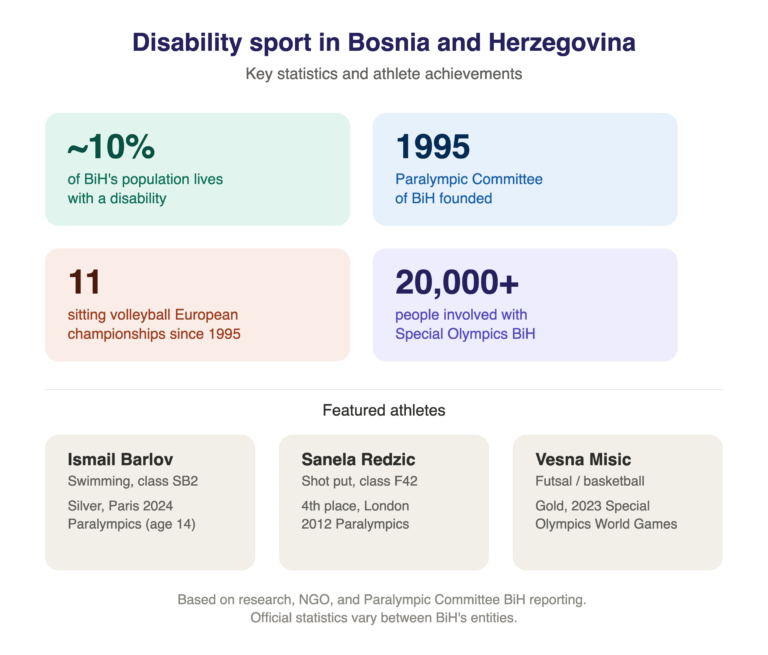
Bosnia and Herzegovina has one of the highest rates of disability in Europe. This is mostly because of the war from 1992 to 1995, the landmines, and the injuries that came after it. Policy documents usually say that around 10% of the population lives with some kind of physical, sensory, intellectual, or developmental disability. But this number is not fully certain, because there is no single national registry of persons with disabilities in the country. Bosnia and Herzegovina has a complicated government system, with the Federation of BiH, Republika Srpska, and Brčko District all having their own social protection systems. This means data on disability is collected in different ways depending on where you are, and it is hard to get one clear national picture.
Sport is one of the areas where inclusion of people with disabilities can be seen the most in BiH. It is also one of the areas where results are the best at the top level, but research shows that participation at the everyday, grassroots level is still much lower than it could be.
What Research Says
Studies about disability sport in BiH and the region all point to the same thing: sport and physical activity clearly help people with disabilities live better, feel better, and connect more with society. But even with this known, the number of people with disabilities who actually take part in sport or recreation is still very small. Researchers mention a few main reasons for this:
- Money problems — many families with a disabled member already pay a lot for therapy, equipment, and transport, so there is little money left for sport.
- Buildings and infrastructure that are not accessible — many sports halls, facilities, and even transport are still not adapted for people with disabilities.
- Attitudes in society — several studies say that negative attitudes from society are actually a bigger problem than physical barriers.
- Not enough adapted programs — many sports clubs do not have staff trained to adapt training or classify athletes by disability type, so fewer people are able to join.
- Even less support for people with intellectual disabilities — awareness about the benefits of sport is even lower here than for people with physical disabilities.
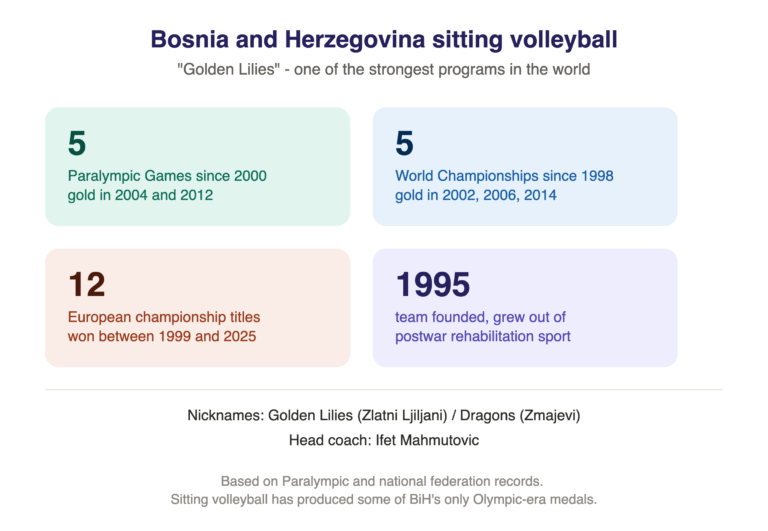
One good example is the research done on Bosnia’s top sitting volleyball players. Almost all of them are people with physical disabilities caused by the war, and the sport itself grew out of rehabilitation programs after the war. This is a pattern that can be seen across the whole region, not only in BiH.
Success at the Top Level
Even with all these problems, Bosnia and Herzegovina actually has a strong record in disability sport at the highest level:
- BiH first competed at the Paralympics in Atlanta in 1996, and has taken part in both the Summer and Winter Paralympic Games since then.
- The national sitting volleyball team is one of the best in the world. It has won medals at several Paralympic Games and World Championships, and has played at the European Championship 11 times since 1995. Sitting volleyball has given BiH some of its only medals ever at the Olympics or Paralympics as an independent country.
- At the 2024 Paris Paralympics, 14-year-old swimmer Ismail Barlov won BiH’s first individual Paralympic swimming medal — a silver in the 50m breaststroke, SB2 class.
- Athletes like Sanela Redžić, who competes in shot put (class F42), have represented the country at World and European Championships, and she also competed at the 2012 London Paralympics.
- The Paralympic Committee of Bosnia and Herzegovina, based in Sarajevo and founded in 1995, is a full member of the International Paralympic Committee and manages this whole system.
Sport for People with Intellectual Disabilities
There is also important, though less visible, work happening for people with intellectual and developmental disabilities:
- Special Olympics Bosnia and Herzegovina, started in 1997, now works with more than 20,000 people with intellectual disabilities across the country. In 2025, it joined the Special Olympics Global Coalition for Inclusion, which aims to give more young people access to inclusive sport and education.
- Programs like “Inclusion through Sports for Children with Developmental Disabilities”, a project with partners from BiH, Iceland, Lithuania, Montenegro, Romania, and Slovakia, and local projects like the “Sunce” School of Sports for Persons with Developmental Disabilities in Banja Luka, give children and young people free access to sport. For many of them, sport works almost like therapy, and it also helps them feel more part of society.
- BiH athletes with intellectual disabilities have had real success internationally too. Vesna Mišić won gold in futsal at the 2023 Special Olympics World Games in Berlin, and also won a regional 3×3 basketball tournament.
- Erasmus+ programs have helped BiH sports organizations build more inclusive practices, both in sport and in education.
The Legal Side
The Law on Sport in Bosnia and Herzegovina says clearly that discrimination based on disability is not allowed. It also officially recognizes the Paralympic Committee of BiH as the body responsible for sport for people with disabilities, next to the regular Olympic Committee. On paper, this should give people with disabilities equal rights in the sports system, and it should mean the state has to support their sporting activities.
But in real life, this is often not the case. There is no single law in the whole country that brings together the basic rights of people with disabilities, and how well these rights are respected changes a lot between the Federation, Republika Srpska, and Brčko District. Groups like the Union of Organisations of Persons with Disabilities in Bosnia and Herzegovina keep pushing for the country to have clearer, more equal standards everywhere.
Overall Picture
So there are really two different stories happening at the same time. At the top level, Bosnia and Herzegovina does very well — the sitting volleyball team and individual Paralympians have brought real success, and a lot of this comes directly from the country’s war history and how rehabilitation and sport grew together after it. But at the everyday level, the situation is not as good. Not enough people with disabilities take part in sport regularly, mostly because of cost, buildings that are not accessible, lack of adapted programs, and attitudes in society that are still one of the hardest things to change.
Closing this gap between elite success and everyday participation is where most of the current work is focused — through EU and Norway-funded projects, Special Olympics programs, and efforts to improve the legal protections for people with disabilities across the country.